

Key points
- The Zelle stablecoin, ZelleUSD, will be launched on the Solana blockchain to enable payments made overseas, Zelle stated at Solana’s Breakpoint 2026 conference held on November 16, 2026.
- Zelle did not give any launch date on stage. In prior statements, the company stated that the first international route, to India, will be ready by the end of 2026.
- Zelle settled over $1.2 trillion worth of US payments in 2025, however, Solana has significantly less stablecoins than Ethereum or Tron.
Table of Contents
Zelle, the US payments network owned by banks, picked Solana as the blockchain for its dollar-backed stablecoin, ZelleUSD.
Zelle is operated by Early Warning Services, a banking consortium that includes JPMorgan and Wells Fargo. The statement was made at Breakpoint 2026, Solana’s annual conference, at which Vice President of Digital Asset Partnerships at Zelle, Alexandra Lang, discussed their plans. The information was reported by Cointelegraph on November 16.
“Solana is a partner we chose because we’re here to deliver payments at scale,” Lang said.
The Zelle stablecoin itself is nothing new. Zelle introduced ZelleUSD back in June, within the same press release where it stated that India was its first country of choice for remittances. Anchorage Digital Bank issues the token. What is new is the platform it will run on.
Why Zelle picked Solana
Zelle’s own domestic service sends money between US bank accounts. The Zelle stablecoin serves another purpose, which is moving money across borders. “We needed a partner that can also deliver at massive scale internationally as well,” Denise Leonhard, general manager of Zelle, explained in a video presentation, which was shown at the conference, according to Cointelegraph.
Another factor emphasized by the companies was that Solana provides some privacy features as well. A customer can use encryption while sending a transfer to keep the transaction amount private from the public blockchain. However, institutions that belong to the Zelle network will be able to decrypt the transaction in order to perform the required AML check-ups. According to Cointelegraph, this is an experimental development.
In August 2026, Solana faced serious difficulties in terms of infrastructure when a routing error occurred at Teraswitch, which took 29% of the Solana network offline, according to Metrika. However, the process of finality was delayed, not stopped. Solana Foundation said at the Breakpoint event that it has moved from beta to mainnet and the finality time decreased from 13 seconds to 150 milliseconds.
The stablecoin gap Solana still has to close
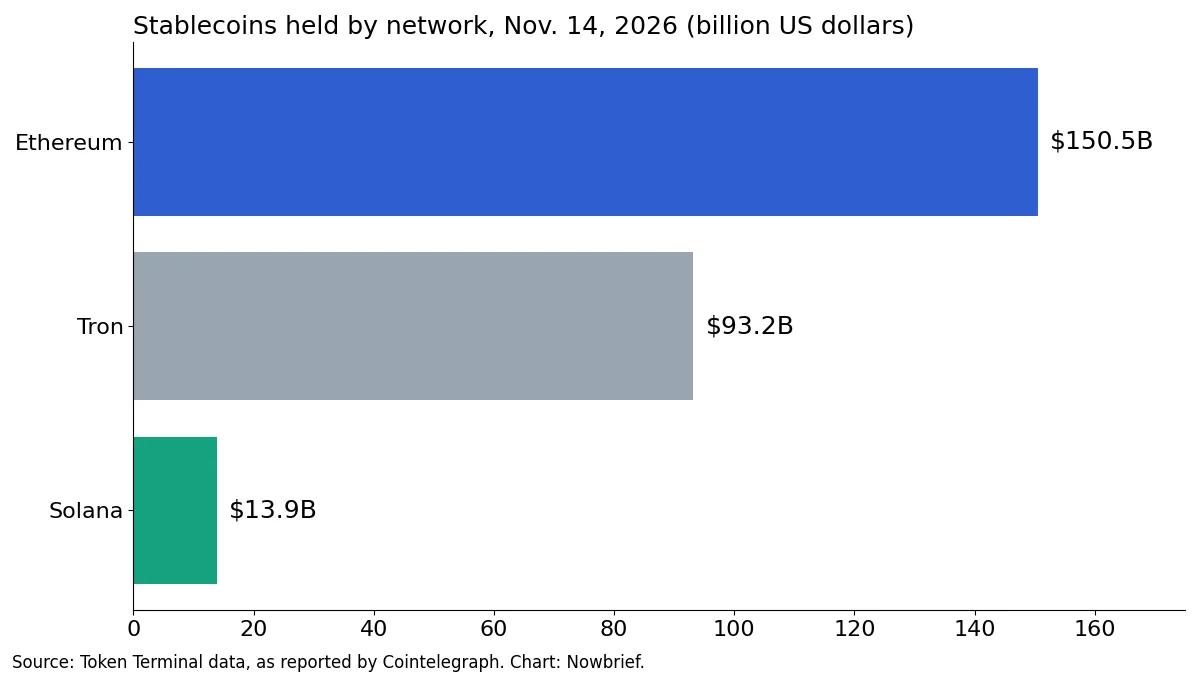
According to Token Terminal figures for Nov. 14, here’s where the cash is parked. $150.5 billion on Ethereum, $93.2 billion on Tron, and the balance $13.9 billion on Solana.
However, growth is a whole different story. The volume of monthly transactions involving stablecoins on Solana grew by 82% year over year in October. On Ethereum, it grew by 48%, and on Tron, it declined almost 8%.
Any Zelle stablecoin that would run on Solana will not revolutionize the industry overnight. The size of the network for Zelle is very large – over $1.2 trillion of payments were done in the US in 2025, but neither the testing network nor the demo at any conferences can be counted as real transactions. The India route is the first real test and end of 2026 is the only timeframe provided by Zelle so far.
What happens next for the Zelle stablecoin
There has been no information on the launch date, price plan, and even the list of countries apart from India that will use ZelleUSD. No details have been provided by Zelle on how users will purchase or hold the token and if the recipients will get local currency.
The statement by Lang on scale is the most accurate indication of Zelle’s intention. Zelle seeks a blockchain which it can depend upon with the same volumes it deals with in its home market, and the selected chain offers the fastest growth of stablecoin transfers but not the largest balances of stablecoins. Our earlier report covers the bitcoin slide to $62,000.
Stablecoin race: MoonPay has applied for a US national trust bank charter.
Related: Polygon plans $50 million to $100 million license deals.