
Key points
- On Nov. 15, 2026, ULA’s Vulcan rocket failed about 10 minutes into its first Amazon Leo launch, and all 40 Amazon satellites on board were lost.
- This marks the first fully failed mission for ULA and occurred during its fifth flight in what was supposed to have been its return to flight following its grounding earlier in the year.
- Amazon had 38 Vulcan launches scheduled, and now the Vulcan rocket failure puts a long break in Amazon’s plan to rival Starlink while the cause is found.
Table of Contents
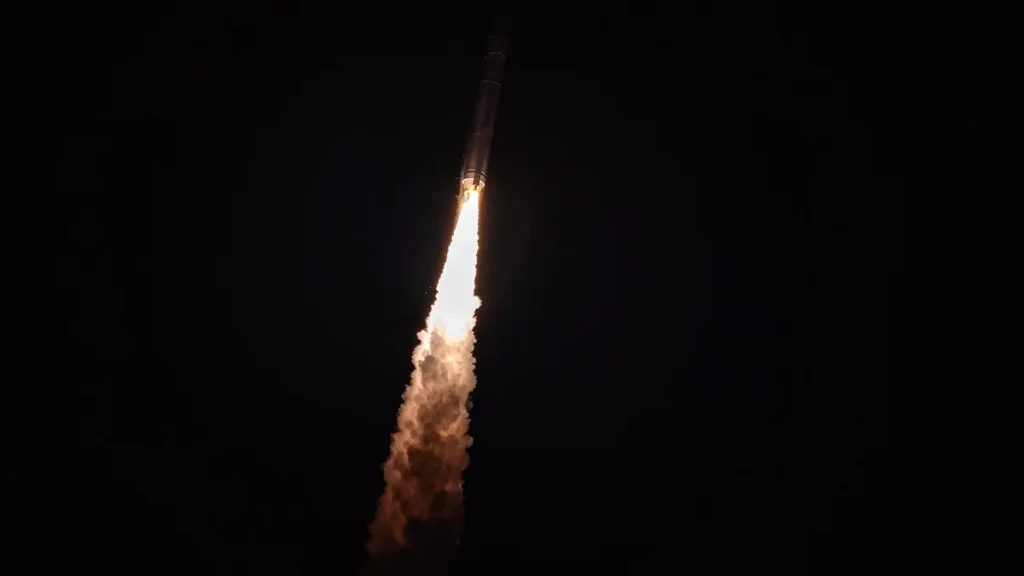
The Vulcan rocket “suffered an anomaly 10 minutes into the flight and failed to deliver the Amazon mission to orbit,” ULA stated, per Via Satellite. Find more space information on our science desk.
What happened to the Vulcan rocket
Launch time was set for 12:40 p.m. ET on Sunday, November 15, from Cape Canaveral Space Force Station in Florida. The vehicle had six Solid Rocket Boosters with Centaur V in the VC6L configuration.
The boosters separated at approximately 1.5 minutes into the flight. Then upper stage ignition and fairing jettison followed at about five minutes. The last update on the broadcast came at around 9.5 minutes and showed the mission on track, but then the broadcast ended without any problem being announced.
First engine cutoff of the Centaur was planned for about 17 minutes into the flight and never happened.
What was lost
The payload consisted of 40 Amazon Leo satellites, the most the constellation has launched on one rocket. This was the first out of 38 planned Vulcan launches by Amazon, that had already completed eight Amazon Leo launches via Atlas V.
According to Amazon’s launch systems director, Vulcan was expected to carry close to 1,500 satellites, “nearly half of our constellation.” However, the future payload number will depend on the flight rate of Vulcan.
Cause of the Vulcan rocket failure
There is no detailed information available from ULA. However, Northrop Grumman stated that initial information indicated the GEM 63XL boosters have performed as expected and they jettisoned before the anomaly. That points away from the boosters, although the report did not name a cause and there is no confirmation.
Vulcan had been grounded after an anomaly in February 2026 involving Northrop Grumman solid rocket motors. That mission still reached orbit, but the Space Force suspended Vulcan national security launches while it was fixed. In that case ULA mentioned that changes in nozzles and tests had been conducted through an investigation.
But this time the anomaly occurred during the upper stage of flight mission. Both incidents should not be taken as similar cases until the investigation concludes otherwise.
What ULA and Amazon said
ULA said the result “did not meet that standard” of mission success. It assured the company that it will work hand-in-hand with the customers and others in order to identify the reason and resume flight operations as soon as possible.
Amazon stated that there is an inherent risk associated with launches, particularly the initial launch of the rocket. It referred to ULA as a “trusted partner”.
Delays before launch
The launch itself had slipped twice already. Initially, it was rescheduled due to a power outage at the industrial gas facility. Second, it got delayed due to a network communication issue between the ground facilities and the spacecraft.
Why the Vulcan rocket failure matters
The Amazon company is making efforts to build its satellite internet system in order to challenge the Starlink by SpaceX company. Amazon can also use Atlas V rockets, but Vulcan had to perform most of the launches. Less frequent rocket launches will result in a slower network.
Regarding national security issues for the US government, the Vulcan rocket is one of the rockets used for such missions. The report does not give any details about possible effects on Space Force missions.
What to watch next
The following are required to look out for. The first is a cause provided by ULA. Second, a return-to-flight date, which was not announced yet. Third, a change of plans by Amazon.
What is known so far is the loss. Forty satellites did not go into orbit on November 15, 2026.